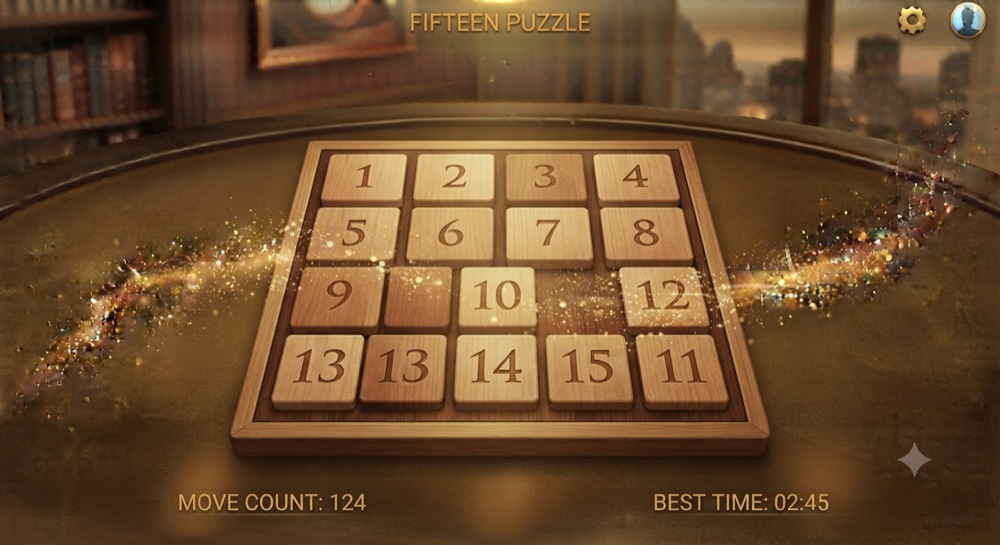
The pocket classic. Fifteen numbered tiles sit in a four-by-four frame with one space free. Tap any tile next to the gap to slide it in — or use the arrow keys once the board is focused. Work the tiles back into order, 1 through 15, with the empty space finishing bottom-right. Fewer moves is better; your best is saved on this device.
- Moves 0
- Time 0:00
- Best —
Quick start
Find the gap
One square of the four-by-four tray is empty. Everything revolves around it.
Slide a neighbor
Tap any tile sharing an edge with the gap and it slides across. Tiles never jump.
Work in order
Settle the top row first, then the second, then finish the bottom two rows together.
Finish at fifteen
Numbers one through fifteen in reading order, gap in the bottom-right corner.
Read the board
However you like to play
Mouse or trackpad
Click any tile beside the gap. Tiles that cannot move do nothing when clicked.
Touch
Tap a tile beside the gap. The targets are large enough to hit without zooming.
Keyboard
Focus the tray with Tab, then use the arrow keys. An arrow slides the neighboring tile into the gap in that direction, so Up pulls the tile below the gap upward.
What actually helps
- Solve the top row, then leave it alone. Once one, two, three and four are home, never disturb them. Work the remaining three rows as a smaller puzzle.
- Place the last two of a row together. Corners are where beginners loop forever. Set the final pair of a row as a unit rather than one tile at a time.
- The record is moves, not minutes. The clock is there for interest. Only the move count is saved, so think first and slide second.
- Eighty is the worst case. No arrangement of this puzzle needs more than eighty single-tile moves. If you are past two hundred, you are undoing your own work.
Is every shuffle solvable?
Yes, always, and by construction rather than by luck. Each shuffle begins at the solved board and walks the empty square through three hundred random legal slides, so a path back always exists.
What does the Best figure track?
The fewest moves in which you have solved a board on this device. It is not a time.
Do the arrow keys work?
Yes. Focus the tray and press an arrow key to slide the neighboring tile into the gap.
Which tiles am I allowed to move?
Only those sharing an edge with the empty square. Diagonal neighbors cannot move, and no tile ever jumps over another.
When does the clock start?
On your first slide, not when the board is shuffled.
Can I reshuffle in the middle of a game?
Yes. Shuffle deals a fresh board at any point, and it resets the move counter.
What is the fewest moves possible?
It depends on the board, but no board of this puzzle ever needs more than eighty single-tile moves to solve.
Where is my record kept?
In your browser's local storage on this device. Clear it whenever you like from the Cookie Policy page.